Automatically translated. Read the Chinese original.

  • Fed Rate Hikes and Oil Prices: Why This ‘Stagflation’ Has Left the Fed in a Tight Spot

    Fed Rate Hikes and Oil Prices: Why This ‘Stagflation’ Has Left the Fed in a Tight Spot

    This article was written on 21 October 2026; the data is current as at 20 October 2026. The dates of the two Federal Reserve meetings mentioned in the article—27–28 October and 8–9 December—are subject to the calendar in effect at the time of publication.

    Soaring oil prices, virtually stagnant employment, and a Federal Reserve that is still raising interest rates

    Let’s look at three things first.

    Firstly: Brent crude is currently trading at US$109 per barrel. Following military action against Iran by the US and Israel at the start of the year, oil prices have risen steadily; in September, US petrol prices rose by 34.2 per cent year-on-year.

    Secondly: US non-farm payrolls rose by just 29,000 in September. By comparison, the figure for August was 133,000. The unemployment rate, meanwhile, rose to 4.2 per cent.

    Thirdly: The Federal Reserve raised interest rates just last month, bringing the federal funds rate to 3.75 per cent–4.00 per cent, and the market is still betting on another hike in December, with the probability having been priced in at as high as 94 per cent at its peak.

    With these three things happening at the same time, something just doesn’t seem quite right. Prices are rising, jobs are becoming scarcer, and the central bank, far from rescuing the economy, is actually slamming on the brakes?

    If you find this unreasonable, congratulations—your intuition has picked up on a genuine contradiction. This article explains exactly why this contradiction exists, why the Federal Reserve finds itself in a bind, and how it relates to your and my mortgage, petrol costs and savings.

  • Claude Opus 5.5 and the Myth of Cheaper AI: Engineering Progress or a Pre-IPO Price War?

    Claude Opus 5.5 and the Myth of Cheaper AI: Engineering Progress or a Pre-IPO Price War?

    I liked Opus 5.5 at first. A stronger model at a lower price was welcome news. I subscribe to both Claude Pro and ChatGPT Plus and use Claude Code and Codex, so I had reason to hope that competition would eventually benefit users.

    But after looking at my own usage records and AA's tests, then reading Fuli Luo's post on inference cost reductions alongside Anthropic's capacity expansion and incident reports, I have become increasingly unwilling to take the "stronger and cheaper" story at face value.

    I am now more inclined to see this as price competition ahead of an IPO: cutting prices to win users and demonstrate growth while still dealing with expensive compute capacity and service delivery problems. That is my interpretation; I do not have access to Anthropic's internal decision-making documents. I want to know how much of the engineering economics behind these cuts has been explained, and how much of the growth investors welcome will translate into benefits for users.

  • With just 8GB of video memory, you can deploy a 30 tk/s multimodal AI in your laptop.

    With just 8GB of video memory, you can deploy a 30 tk/s multimodal AI in your laptop.

    My Laptop is a very ordinary gaming Laptop: a Ryzen 7 8845H, 16GB of RAM, an RTX 4060 Laptop, and only 8GB of video memory. According to many people's impression, this configuration can only be used to "play around" with local large models.

    But now, when I double-click a startup file every day, the browser opens a chat page: I can view images, watch videos, switch the depth of my thinking, and call native tools. My text generation speed is approximately... 31 tokens/sThe entire process involves no internet connection and no API fees. The one running inside is Qwen3.5-9BThe reasoning framework is llama.cpp。

    This article is divided into three parts: How I chose the framework and model; An installation tutorial for beginners, written for every command; And the pitfalls I've encountered and the corresponding solutions.

  • Gemini 4 Argon: The reasons I like Gemini are all written in Argon this time.

    Gemini 4 Argon: The reasons I like Gemini are all written in Argon this time.

    Yesterday, Google officially announced Gemini 4 Argon。

    Strictly speaking, this is not a regular release that "everyone can use it now". Argon is being handed over to a group of trusted cybersecurity defenders through the Fairwind Program, and Google is also participating in the US government's pre-release model access process. Paid API users and Google AI Ultra users will be next in line, but Google has not given a specific date.

    However, if we only understand it as a cautious grayscale launch, we would underestimate this update. From Google's announced design goals and internal use cases to the third-party testing that has already emerged, Argon is trying to answer a question more important than "Is chatting smarter?":

    Can a cutting-edge model work continuously for tens of minutes, hours, or even longer, identifying problems, calling tools, reflecting, modifying, and actually getting things done?

    This is exactly what I've always loved about Gemini. Rather than simply pursuing a sense of amazement in conversation, I prefer Google's direction of integrating multimodality, long context, tool calls, and real workflows into a complete system. Argon may not be number one in every test yet, but it is currently the next-generation Gemini that most closely resembles the final form of this approach.

  • Why Jev became popular: When AI stopped writing answers and instead made judgments for the software.

    Why Jev became popular: When AI stopped writing answers and instead made judgments for the software.

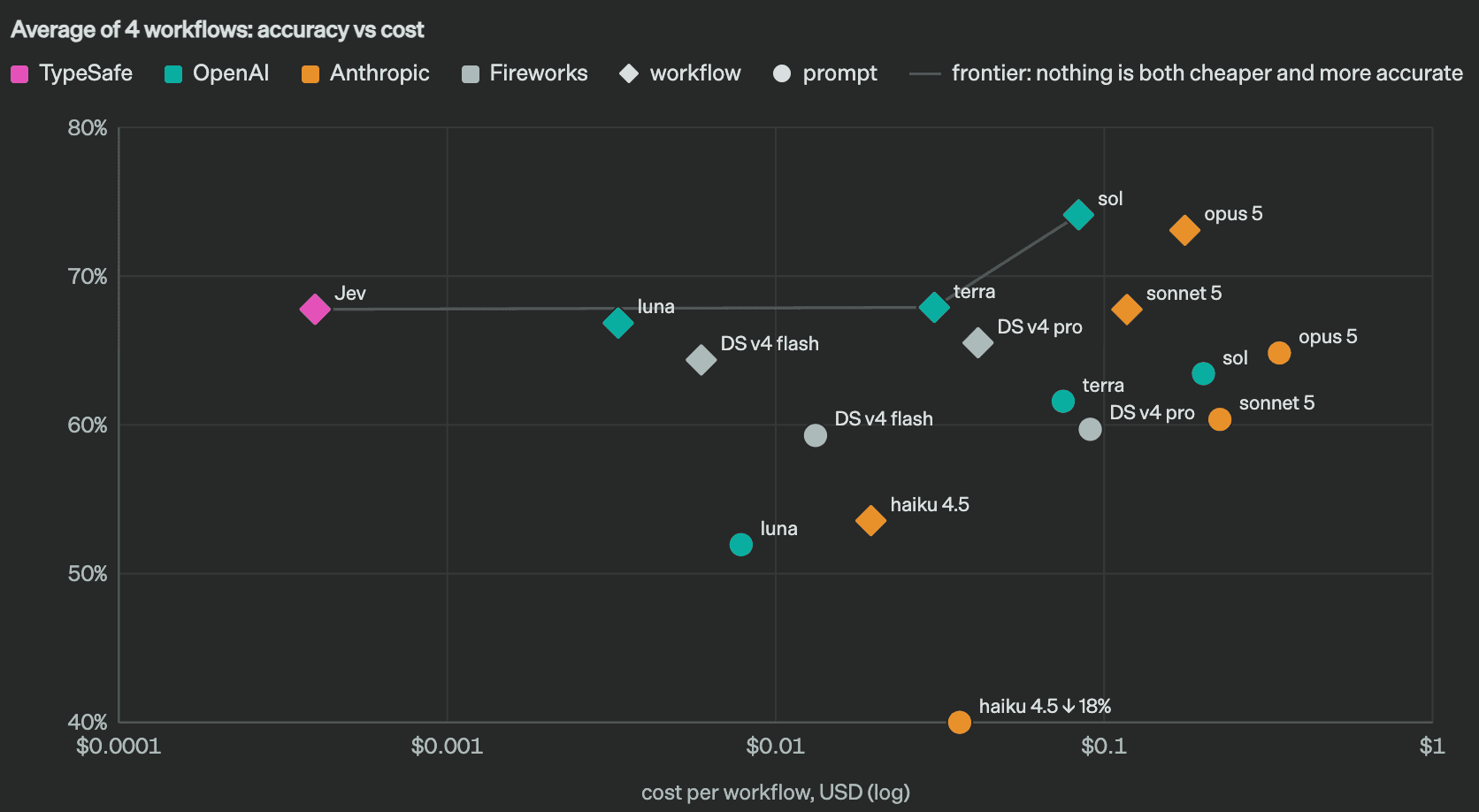
    TypeSafe AI official review image: Jev compared to other models in terms of workflow accuracy and cost. Image source: Jev published by TypeSafe AI. This is the company's own workflow evaluation diagram. See below for specific comparison conditions and limitations. An email arrived: "You've deducted money from my account twice. If it doesn't get processed today, I'll file a complaint." The customer service system's next task isn't mysterious: identify this as a billing issue, determine if it's urgent, find the order, and then decide who to hand it over to. In the past, we...
  • ECON3116 What We Learned from International Trade Theory and Policy: A Complete Review Note on From Comparative Advantage to Trade Policy

    ECON3116 What We Learned from International Trade Theory and Policy: A Complete Review Note on From Comparative Advantage to Trade Policy

    The English course name of ECON3116 is International Trade Theory and PolicyThat is, international trade theory and policy. This course doesn't just discuss "why countries exchange goods," but revolves around a complete economic theme: why different countries, industries, and companies form different trade patterns. How open trade can expand production and consumption possibilities; Why aren't trade gains automatically distributed equally domestically? And how prices, income distribution, and overall welfare change when governments use tariffs, quotas, subsidies, and trade agreements.

    After completely organizing the Lectures, tutorials, Quick quizzes, formula lists, and calculation problems, I understood the entire course as a four-layer interconnected framework: the first layer is...Source of tradeThis includes productivity differences, factor endowment differences, and economies of scale; The second layer isTrade resultsThis includes specialization, relative prices, income distribution, and welfare; The third layer isEnterprise and market structureExplain product differentiation, heterogeneous enterprises, exports, and FDI; The fourth layer isTrade Policy and SystemExplain protectionism, political incentives, the WTO, and preferential trade agreements.

  • ECON3124 What I Learned in Behavioral Economics: Complete Notes from Core Theories to Final Review

    ECON3124 What I Learned in Behavioral Economics: Complete Notes from Core Theories to Final Review

    ECON3124 is Behavioural Economics. Instead of taking "human irrationality" as a conclusion, it systematically asks three questions above the standard economic model: How exactly do human preferences deviate from the standard model? Why do people's beliefs go systematically wrong? When these people compete with each other, how will market outcomes and public policy change?

    In the process of completely reviewing this course, I gradually organized the content scattered in the handouts, tutorials, and mock exams into a set of interconnected frameworks, and deepened my understanding by using a cycle of concept recognition, formula modeling, independent exercises, error diagnosis, and targeted retesting. Below is both a course knowledge map and a summary of how to systematically review behavioral economics.

  • Zhongyuan Festival: The 15th day of the seventh lunar month for Chinese people, from ancestor worship and Obon to Zhongyuan tradition.

    Zhongyuan Festival: The 15th day of the seventh lunar month for Chinese people, from ancestor worship and Obon to Zhongyuan tradition.

    The fifteenth day of the seventh lunar month is called "Zhongyuan Festival" or "July and a Half" in many parts of China. If we only understand it as the "Ghost Festival", we will actually miss a more important aspect of this festival: it is related to the ancient traditions of autumn sacrifice and ancestor worship, and has also absorbed the Taoist concept of "Zhongyuan" and the Buddhist tradition of Obon. Later, rich customs such as ancestor worship, popularization, releasing river lanterns, and inviting family members have developed in different regions. The reason it has truly lasted for over a thousand years is not due to mysterious legends, but to how Chinese people face death, remember loved ones, maintain family relationships, and how they integrate "remembering the past" into the order of life throughout the year.

1234